Will an EV Charger and a Heat Pump Max Out Your Electrical Panel?
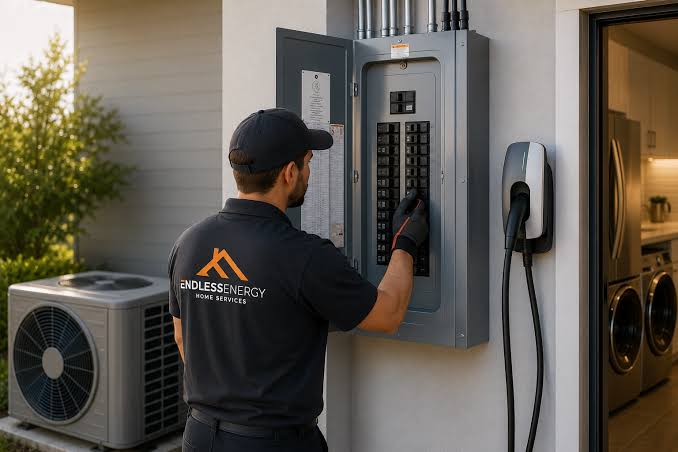
You decide to get an electric car. You also want a heat pump. Somewhere in the third conversation, an electrician says the words “you’ll need a service upgrade,” and quotes $4,000 to $10,000.
Thank you for reading this post, don't forget to subscribe!That quote is sometimes correct. It is also, very often, the answer you get when nobody has done the arithmetic and the safest reply is to sell you more capacity.
The Canadian Electrical Code has contained tools for years that let homes electrify without ripping out the service. Most homeowners have never heard of them. Some electricians do not use them. Here is what is actually going on inside your panel and what your real options are.
Two Different Limits Get Confused Constantly
When people say “my panel is full,” they usually mean one of two very different things.
Physical breaker spaces are how many slots exist in the box. Running out of slots is a nuisance and is often solved with tandem breakers or a small subpanel for a few hundred dollars.
Service capacity is how many amps the utility feed, the meter base, the main breaker, and the panel bus are rated to carry. Running out of capacity is the expensive problem.
A 100 amp panel with no free slots and plenty of spare capacity is a cheap fix. A 100 amp panel with three free slots and no spare capacity is not. Ask any electrician which one you have before you accept a price.
| Situation | What it means | Typical cost to solve |
| Out of breaker slots, capacity fine | Physical space only | $300 to $1,200 |
| Panel is old and obsolete, capacity fine | Panel swap at same amperage | $1,800 to $3,500 |
| Out of calculated capacity | Service upgrade needed, or load management | $3,000 to $10,000, or a few hundred |
| Utility feed itself undersized | Overhead or underground conductor replacement | $4,000 to $15,000 |
How the Load Calculation Actually Works
Canadian electricians size services using the calculation in Section 8 of the Canadian Electrical Code. The single-dwelling method builds a number out of fixed allowances rather than measuring anything.
It starts with a base allowance for the floor area. It adds specific allowances for a range and for other large appliances. It counts electric space heating with a demand factor. It adds electric vehicle supply equipment. It counts additional loads over 1,500 watts at a reduced percentage.
Here is roughly what that looks like for a typical Canadian home. Exact rules and provincial amendments vary, so treat this as illustrative, not as a substitute for your electrician’s actual calculation.
| Load item | Typical calculated contribution |
| Base allowance for first 90 m² of living area | 5,000 W |
| Each additional 90 m² or part thereof | 1,000 W |
| Electric range | 6,000 W plus a portion above that |
| Electric water heater, dryer, other loads over 1,500 W | Counted at a reduced percentage |
| Electric space heating | First 10 kW at full, remainder at a reduced factor |
| Electric vehicle supply equipment | Counted at full rating unless managed |
| Air conditioning or heat pump | The larger of heating or cooling, not both |
Divide the total watts by 240 volts and you get the calculated amps. Compare that to your service rating.
The number that surprises people
A 1,900 square foot house with a gas furnace, gas water heater, gas dryer, and an electric range calculates out very comfortably on 100 amps. There is often 30 to 50 amps of calculated headroom sitting unused.
Now add a 40 amp EV charger circuit and a heat pump with 10 kW of electric backup. Suddenly the calculation exceeds 100 amps, and the conversation turns to upgrades.
Notice what happened. The house did not change. The calculation added two loads at full value that will almost never run at full value at the same time.
That gap between calculated load and actual load is where all the good options live.
The Code Already Solved This, and It Is Called Load Management
This is the section worth reading twice, because it is where thousands of dollars either get spent or do not.
Electrical codes are conservative by design. They assume worst case. Your actual house has never drawn anything close to its calculated load, and your utility has the data to prove it.
Using real demand data instead of assumptions
The Canadian Electrical Code contains a provision allowing a service to be evaluated against actual measured demand rather than the standard calculation, when at least a year of demand data is available and appropriate headroom is added for the new load.
In plain terms: your electrician can pull your metered peak demand history, see that your house has never exceeded, say, 45 amps, add the new loads, and demonstrate that 100 amps is sufficient.
This provision has been in the code since the 2018 edition. Provincial adoption and interpretation vary, and your authority having jurisdiction may have specific requirements about how the data is obtained and documented. Ask your electrician directly whether they use it. Many do not, simply out of habit.
Energy management systems change the calculation itself
The second tool is more powerful. An electric vehicle energy management system, addressed in Section 8 of the code, allows an EV charger’s contribution to the load calculation to be based on the maximum current the management system will permit, rather than the charger’s full rating.
The device monitors total service current in real time. When the house approaches its limit, the system reduces or pauses EV charging. When the house load drops, charging resumes.
Since your car is parked for eight to twelve hours overnight, a brief pause while the dryer and the oven both run costs you nothing. The car still charges. The service never exceeds its rating.
| Approach | How it works | Typical cost | Effect on load calculation |
| Load monitoring only | Reports usage, takes no action | $200 to $600 | None, informational |
| Circuit-level load shedding | Cuts a specific circuit when needed | $400 to $1,200 | Can reduce counted load |
| EVEMS with current sensing | Throttles EV charging based on service current | $500 to $1,500 | EV counted at managed level |
| Dryer or range splitter | Shares one circuit between two loads | $400 to $900 | Only one load counted |
| Smart panel with per-circuit control | Full panel replacement with metering and control | $4,000 to $8,000 | Extensive control and data |
| Full service upgrade to 200 A | New meter base, panel, conductors, utility work | $3,000 to $10,000 | Removes the constraint entirely |
Read down the cost column. A $700 device that solves the same problem as a $7,000 upgrade is worth a conversation.
Load shedding, load sharing, and monitoring are different things
The terms get used interchangeably by salespeople, which causes confusion.
Monitoring just tells you what is happening. Useful for understanding your house, useless for satisfying a code calculation on its own.
Load sharing allows two loads to use one circuit, but never at the same time. The classic example is a device that sits between your dryer outlet and an EV charger, giving priority to whichever was requested first.
Load shedding actively reduces or disconnects a load when total demand approaches a threshold. This is what an EVEMS does, and it is the one that changes the calculation.
Make sure the device your electrician proposes is certified for the purpose and accepted by your provincial authority. Not every product on the market is.
Adding an EV Charger Without Touching the Panel
Four workable paths, ordered from cheapest to most involved.
Level 1 charging is dismissed too quickly
A standard 120 volt outlet delivers roughly 1.4 kW, which adds about 8 kilometres of range per hour. Over a twelve-hour overnight charge, that is roughly 95 to 100 kilometres.
The average Canadian drives around 40 to 50 kilometres a day. Level 1 covers that comfortably, on a dedicated 15 amp circuit that most garages already have.
It fails for high-mileage drivers, for households with two EVs, and for anyone who regularly returns home with a nearly empty battery. For everyone else, it costs nothing and is worth trying for a month before spending on anything else.
Dial the charger down
Nearly every Level 2 charger sold in Canada has an adjustable maximum current, set during installation. A charger capable of 48 amps can be configured for 24 amps, halving its load contribution.
A 24 amp Level 2 charger delivers about 5.8 kW, adding roughly 35 kilometres of range per hour. Ten hours overnight is 350 kilometres. That is more than enough for the vast majority of households and it costs the same as installing it at full current.
Homeowners install 48 amp chargers because bigger sounds better. Almost nobody needs it at home.
Share a circuit you already have
A dryer outlet is typically a 30 amp, 240 volt circuit that sits idle 95% of the time. Certified splitter devices let an EV charger share that circuit, giving the dryer priority automatically.
No new circuit, no calculation increase, and installation is usually a couple of hours.
Add an EVEMS
If none of the above fits, the current-sensing management system described earlier is the answer. It lets you install a full-power charger while capping the total service draw.
Adding a Heat Pump Without Touching the Panel
The heat pump itself is rarely the problem. The backup heat usually is.
Right-size the equipment first
A 3 ton cold-climate heat pump typically needs a 20 to 30 amp circuit. That is modest. A 5 ton unit needs considerably more, and it is often a 5 ton unit only because nobody did a heat loss calculation.
Air seal and insulate first, calculate to CSA F280-12, and the equipment gets smaller. Smaller equipment draws less current. This is the same sequencing argument that governs every other part of a retrofit, and it applies to your panel too.
The electric backup is the real load
Ten kilowatts of electric resistance backup draws about 42 amps at 240 volts. Twenty kilowatts draws about 83 amps. That is where a 100 amp service goes over.
Three ways to shrink it. Size the backup to the actual gap between heat pump capacity and design load rather than to the whole load. Stage the backup so only part of it energizes at once, controlled by outdoor temperature. Or eliminate electric backup entirely with a dual-fuel setup that keeps your existing gas furnace as the deep-cold source.
That last option is why dual-fuel is so common in Canadian retrofits. It removes the largest electrical load from the equation.
Heating and cooling are not counted together
Worth knowing because it catches people out. The load calculation counts the larger of the heating load or the cooling load, not the sum, since they cannot run simultaneously. A heat pump serving both is counted once.
When You Genuinely Do Need the Upgrade
Load management is not a universal answer. Some situations require real capacity.
- You have a 60 amp service, which is common in pre-1960 homes and rarely worth working around
- The existing panel is an obsolete or recalled type that insurers refuse to cover
- Your calculated load exceeds the service even after right-sizing and management
- You are planning two EVs, whole-home electrification, and a workshop
- The panel bus, meter base, or service conductors are damaged, corroded, or undersized
- You are already opening walls for a major renovation, so incremental cost is low
- Aluminum service conductors show signs of overheating at terminations
If two or more of those apply, the upgrade is probably worth doing once rather than fighting the constraint repeatedly.
Smart Panels Are Interesting, But Not Always the Answer
A smart panel replaces your load centre with one that meters and controls every circuit individually. It can shed loads intelligently, report consumption per circuit, and integrate with solar and batteries.
They are genuinely useful and they are expensive, typically $4,000 to $8,000 installed. That is often more than a conventional service upgrade.
Buy one because you want circuit-level data, battery integration, and granular control. Do not buy one purely to avoid a service upgrade, because a $700 EVEMS usually accomplishes that specific goal for a tenth of the price.
The Question To Ask First
Before accepting any upgrade quote, ask your electrician to show you the completed Section 8 calculation for your house with the new loads included, because until that page exists nobody actually knows whether you need one.
Putting It Together
Most Canadian homes with 100 amp service can add both a heat pump and an EV charger without a service upgrade. It requires three things: right-sized heating equipment based on a real heat loss calculation, a sensible approach to backup heat, and either a charger configured at moderate current or a load management device.
The order to work through it:
- Do the envelope work first, so the heat pump can be smaller.
- Get a CSA F280-12 heat loss calculation and size the equipment to it.
- Decide on backup heat: staged electric, or dual-fuel with your existing furnace.
- Have an electrician run the Section 8 calculation with the real proposed equipment.
- If it is over, ask specifically about demand-data-based evaluation and about a certified EVEMS.
- Try Level 1 charging for a month before assuming you need Level 2.
- Upgrade the service only if the calculation still fails, or if the existing panel has its own problems.
The upgrade is not a scam and sometimes it is exactly right. It just should not be the first answer, and it should never be the answer before anyone has run the numbers.